“How do you convince young people to study literature? Concretely, what’s in it for them?” I remember this rather curt question asked by an American friend as I was talking about the value of studying literature, and the lack I felt after having stopped it by going to business school. I felt like replying that there was nothing concrete to be expected from any study, and that this was almost what defined studies and their necessity, happy with the apparent paradox of my answer and the affirmation of a right to uselessness that already seemed to me threatened, and essential for this very reason.
Despite all this, and perhaps because I’d never asked it of myself, this question continued to follow me for years. Was it the importance of style, of studying the great authors to learn how to write or speak better? Was it a question of culture, of mastering common references so as to be able, if not to shine in society, at least to understand certain allusions and feel part of it? Was literature at last teaching us something, lessons from experience, a bit like studying history to avoid repeating its mistakes?
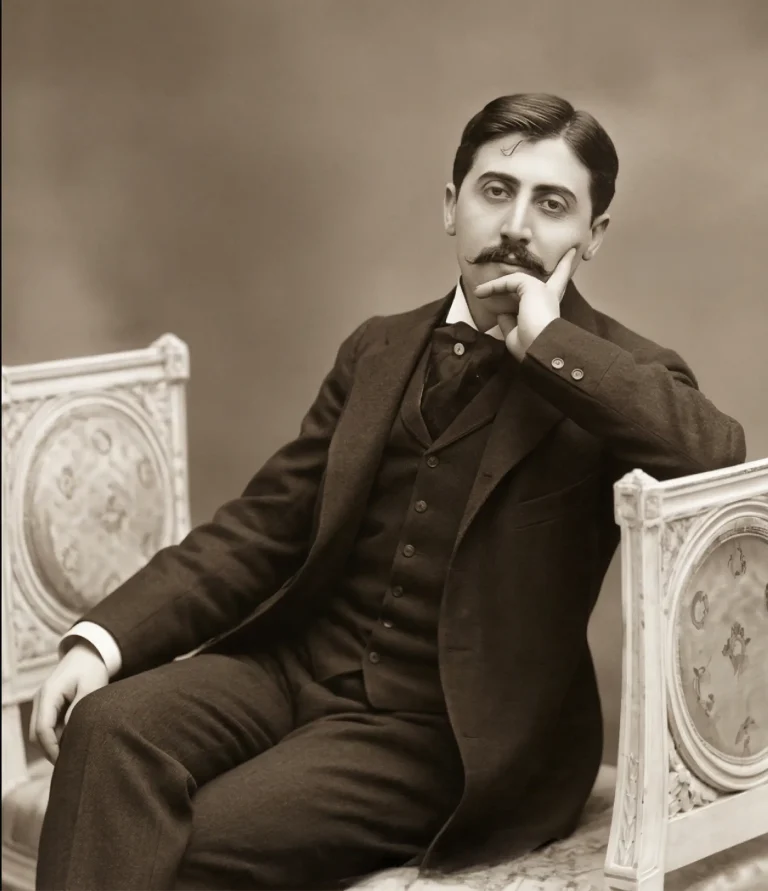
Another question asked by a friend more recently also got me thinking. Why is Marcel Proust so successful? What do we love about him, what gives him such a singular place in literature and in the world?
Although the first question is general and the second specific, it seems to me that the answer is the same: the expression of feeling, in the broadest sense, the fine observations that make us recognize ourselves or understand, and that can be translated into what Barthes called the ‘c’est ça!’, a very simple expression translating the immediacy of the relationship to literature, which means that suddenly, we no longer feel alone because we’ve recognized ourselves in another. Literature is a big word, perhaps wrongly impressive, just as philosophy is rightly impressive, because it connects to the intellect and concepts, to principles, whereas literature is life in motion, stories, feelings and contradiction – principles yes, as long as you don’t respect them, and this lack of respect is in truth the deeper mark of fidelity.
Reflecting more specifically on the question about Proust and his heritage, I thought that I didn’t often dare talk about him or recommend him for reading, because I was afraid of being opposed to the difficulty of his language and style, and afraid of the opinion that would follow, which might make me react like the Narrator’s grandmother, to Madame de Villeparisis, who tells her she doesn’t understand his interest in Mme de Sévigné:
“‘Don’t you think this constant concern for her daughter is a little exaggerated, she talks about it too much for it to be sincere. She lacks naturalness’ My grandmother found the discussion pointless, and to avoid having to talk about the things she loved in front of someone who couldn’t understand them, she hid Mme de Beausergent’s Memoirs by putting her bag on top of them. “.
It seems to me, however, that reading La Recherche, because it’s an immense work that embraces human nature, the power of memory and the value of time, but always with an eye that curls (because Proust is above all very funny), should touch everyone, in the sense that anyone could recognize themselves in an observation and still think, “And to think I thought I’d experienced that thing all by myself!” and suddenly feel that the world expands and that one’s fellow man can be a brother.
I believe that La Recherche du temps perdu presents three main categories, which spend their time intermingling:
And it’s this constant shifting between the three levels that gives the story its charm, as the most insignificant detail can be translated a few lines later into a maxim that seems precisely suited to something we’ve experienced. Rather than remain theoretical, I propose to explore these ideas through three extracts from La Recherche. I’ve highlighted in bold (Proust would be shocked!) those moments when we’re no longer in the story or in the Narrator’s memories, but when we switch to the third level and the famous maxims that seem to me to illustrate particularly well the feeling of ‘c’est ça!’ :
The Narrator, still a child, is in love with Gilberte Swann, whom he sees on the Champs-Élysées. After a falling out, he hopes that the new year will mark a new beginning, but soon finds his hopes dashed.
“It was a time I knew; I had the sensation and the presentiment that New Year’s Day was no different from any other day, that it was not the first of a new world where I could, with my luck still intact, renew my acquaintance with Gilberte as in the time of Creation, as if there were no past, as if the disappointments she had sometimes caused me had been wiped out, along with the clues one could have drawn from them for the future: a new world where nothing remained of the old… nothing but one thing: my desire for Gilberte to love me. I understood that if my heart wished to renew around him a universe that had not satisfied him, it was because he, my heart, had not changed, and I told myself that there was no reason for Gilberte’s heart to have changed any more; I felt that this new friendship was the same, just as the new years that our desire, without being able to reach and modify them, unwittingly covers with a different name, are not separated from the others by a gap. However much I dedicated this one to Gilberte, and as one superimposes a religion on the blind laws of nature, tried to imprint on New Year’s Day the particular idea I had formed of it, it was in vain; I felt that it didn’t know it was called New Year’s Day, that it ended in twilight in a way that was not new to me: in the gentle wind that blew around the poster column, I had recognized, I had felt the eternal, common matter reappear, the familiar dampness, the ignorant fluidity of the old days.
I returned home. I had just experienced the January1st of old men who differ from young men on this day, not because they no longer receive presents, but because they no longer believe in the New Year. I had received a few, but not the only ones that would have pleased me, and not the only ones that would have been a word from Gilberte. And yet I was still young, because I was able to write her one, in which I hoped that by telling her the lonely dreams of my tenderness, I would awaken similar ones in her. The sadness of men who have grown old is that they don’t even think of writing such letters, whose ineffectiveness they have learned. ”
Here, Proust captures that very special feeling that comes over us when we expect an external event – a new year, a trip, a meeting – to refound our inner life. Our thirst for drama would like the scenery to change with us, and for the world, as it turns the page on one year, to also turn that of our sorrows, or to catch fire for our ambitious new adventure. But the wind blowing around the column of posters is the same as the day before, and it’s precisely this indifference to the world that brings us back to ourselves. What’s even more interesting is that the real change eventually takes place, not in the scenery, which retains its “familiar dampness”, but in us, mutedly, as the years go by: disillusionment does its slow work, taking away not love but the hope of being loved, which perhaps amounts to the same thing.
“Evening was falling; we had to get back; I was taking Elstir back to his town, when all of a sudden, like Mephistopheles appearing before Faust, there appeared at the end of the avenue a few spots of gasoline impossible to confuse with anything else, a few sporads of the zoophytic band of young girls, who seemed not to see me, but no doubt were nonetheless passing ironic judgment on me. Feeling that the meeting between her and us was inevitable, and that Elstir would call me, I turned my back like a bather about to receive the blade; I stopped dead in my tracks, and leaving my illustrious companion to continue on his way, I remained behind, leaning, as if suddenly interested in her, towards the window of the antique dealer we were passing at the moment; I wasn’t angry that I seemed to be able to think of anything other than these young girls, and I already knew that when Elstir called to introduce me, I would have the sort of questioning look that reveals not surprise, but the desire to look surprised – so bad an actor is everyone, or the next person a good physiognomonist – that I’d even go so far as to point to my chest with my finger to ask ‘is it really me you’re calling?’ and hurry over, my head bowed in obedience and docility, my face coldly concealing the boredom of being snatched from the contemplation of old earthenware to be introduced to people I had no wish to know.”
We recognize here a somewhat shameful and widely shared feeling: that of becoming, for the space of a moment, the actor in an episode of one’s own life. The scene hasn’t taken place, Elstir hasn’t yet called the Narrator, and yet everything is already prepared within him: the gesture of the finger towards the chest, the “Is it really me you’re calling?”, the face that will conceal the boredom of being torn away from the contemplation of old earthenware. Even if we’ve probably never performed this exact scene, we’ve all experienced something close to it: that inner preparation for the natural, that tiny stage fright before an expected event, that acute awareness of our own image at the precise moment when we’d like to appear not to be thinking about it.
The Duc de Guermantes, a neighbor of the Narrator’s family, comes to pay his first visit to the parents, having learned that the grandmother was about to die (“the news that my grandmother was at any extremity had immediately spread through the house.”). Here are Guermantes’s words: ‘I have just learned, my dear sir, of this macabre news. As a sign of sympathy, I would like to shake hands with Monsieur your father.’ The timing is bad, the grandmother isn’t dead yet, and no one in the house is willing to receive such a visit. “I’d have liked to hide it anywhere,” says the Narrator, embarrassed to impose a social visit on his mother at the worst time of her life.
“But persuaded that nothing was more essential, could moreover flatter her and was more indispensable to maintaining his reputation as a perfect gentleman, he took me violently by the arm and despite my defending myself as if against rape with repeated ‘Monsieur, Monsieur, Monsieur’, he dragged me towards Maman, saying ‘Voulez-vous me faire le grand honneur de me présenter à madame votre mère?’ derailing a little on the word mère. And he felt so strongly that the honor was for her that he couldn’t help smiling as he made a figure of speech. I had no choice but to name him, which immediately triggered bows and entrechats on his part, and he was about to begin the whole ceremony of greeting.”
It wasn’t that the Duc de Guermantes was ill-bred, on the contrary. But he was one of those men incapable of putting himself in other people’s shoes, one of those men who resemble most doctors and morticians and who, after putting on an appropriate face and saying ‘these are very painful moments’, kiss you if necessary and advise you to rest, now regard an agony or a funeral as no more than a more or less restricted social gathering where, with joviality compressed for a moment, they look for the person to whom they can talk about their little affairs, ask to introduce them to another or ‘offer a place’ in their car to take them home.
What’s admirable here is that the Duke’s rudeness, which comes at such a painful moment for the Narrator, is not explained by a lack of education but, on the contrary, by excess. Guermantes knows the codes too well; he executes them with such care that he forgets what they were meant for. Curtsies and entrechats become empty gestures, performed for their own sake, and the Narrator’s acute awareness of his own rank in the face of his bourgeois relatives takes the place of tact, modesty and common sense. It’s one of Proust’s great subjects, and one of the funniest: the aristocracy as a machine for producing social awkwardness through excessive refinement. And it’s also here that we touch on something deeper: that in the darkest moment, Proust finds a way to make us laugh, not in spite of the pain, but alongside it. Humor saves because it looks, and in looking it transforms the scene into comedy without taking anything away from the sadness.
To return to the questions that opened this reflection, it seems to me that the interest of literature lies perhaps in this: the knowledge – which is often recognition – of the complexity of human feelings and the human species; the feeling of being less alone when we discover, through the pen of another, a nuance that we thought only we had experienced; to the idea that humor saves us from everything, from heaviness, from coarseness, from the passage of time; and to the intuition that there is, in the most common things, a part of immortality and beauty that waits only for Art to reveal itself – each reader then recreating, in his or her own way, a vanished world.