Conversation and Language Learning
A Lesson from a Very Old Memory
I was seven years old when my parents hosted a family friend and her sixteen-year-old English pen pal for about two weeks. She was very shy and didn’t dare speak in front of adults; I suggested she talk with me, away from the others. I remember how hard we both tried to speak clearly, our bond, and our laughter.
I wouldn’t be able to say today just how much progress he had made, but we had been speaking French more and more fluently.
Around a Short Story
Later, as a student at the ENS, alongside my university coursework, I took English classes taught by an American woman for one semester. We would form a small group to discuss a short story by Henry James or Katherine Mansfield, sharing our interpretations of the texts. There were no academic stakes—no grades, no evaluations—and without even realizing it, we improved our English skills and gained confidence.
The Art of Conversation
A rhetorical practice
Conversation relies on well-honed rhetorical skills: listening to the other person, responding to them, choosing a tone of voice appropriate to the situation, and, above all, observing the rules and conventions of politeness.
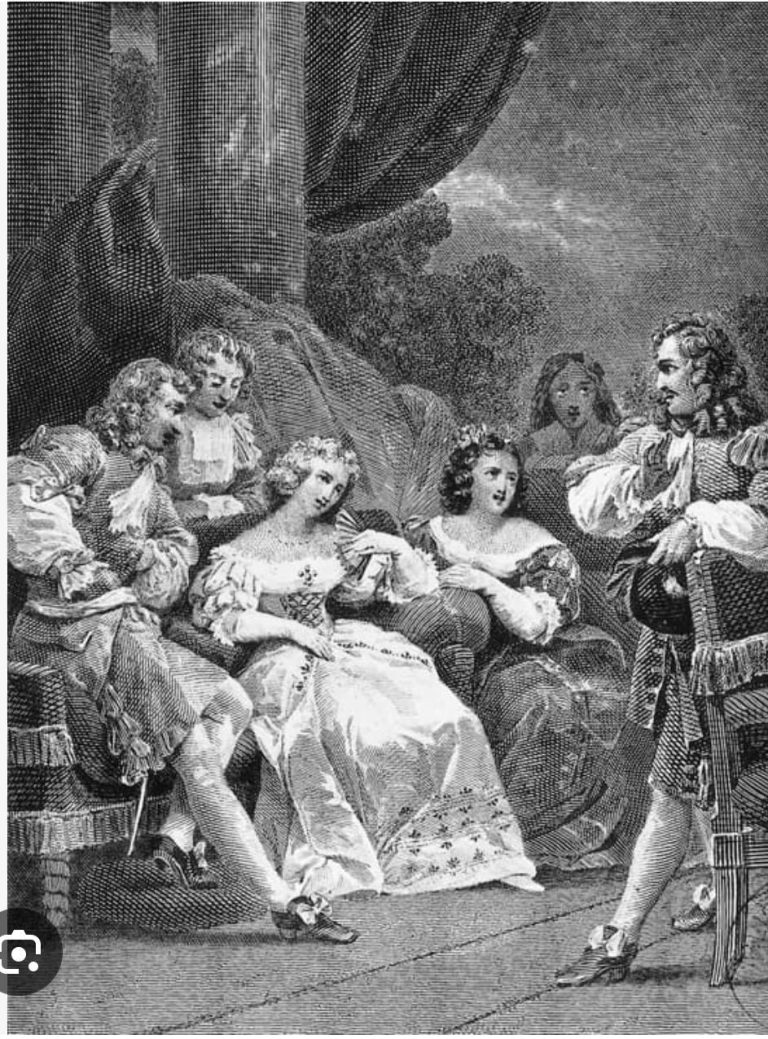
Several of Molière’s comedies reflect his essential role in human relationships: for example, *The Misanthrope* (1666) gives center stage to the character of Célimène, a young, highly sought-after widow and a brilliant conversationalist. Here, she mocks a certain Bélise:
“What a dull woman’s mind, and what a dry conversation!”
You have to constantly rack your brain trying to figure out what to say to him,
And the barrenness of his expression
“It kills the conversation every time.”
The Misanthrope, 1666, Act II, Scene 4.
Poor Bélise—whose first name cruelly echoes the word “stupidity”—is thus rejected for her lack of intelligence, her inability to converse in social settings, and for the disastrous effect her presence has on a gathering: she hinders the flow of conversation and undermines the very purpose of these social gatherings.
In the background emerges the portrait of the ideal hostess—creative, cheerful, and capable of enlivening gatherings of brilliant minds.
In the 16th century, treatises such as *The Courtier* by the Italian Baldassare Castiglione were already emphasizing two essential points: say nothing that is “inappropriate” or shocking, and say nothing that might sadden the people with whom you are speaking.
A Social Art
The art of conversation is thus a social art. For a long time, it was practiced in salons where real people gathered; it moved outdoors to parks and gardens—both English and French—and to cafés such as “La Régence” in 18th-century Paris; it is also depicted in novels. For example, the five volumes of *L’Astrée* by Honoré d’Urfé, published between 1607 and 1627, brought to life characters of shepherds and shepherdesses who speak of friendship and love, away from the clamor of the world, far from wars and city politics, in an idealized rural setting. A 17th-century bestseller, known to people of all walks of life—from the most sensitive to the most serious of the era—this work brilliantly illustrates the power and charm of conversation and inspires readers to speak more eloquently in order to love more deeply.
It is precisely this spirit of “French-style” conversation that Passages seeks to recapture through a lively engagement with the language and culture. Conversation thus emerges as both a means of learning the language and an enjoyable activity that offers both knowledge and pleasure.